 OKC Mobile Mechanic
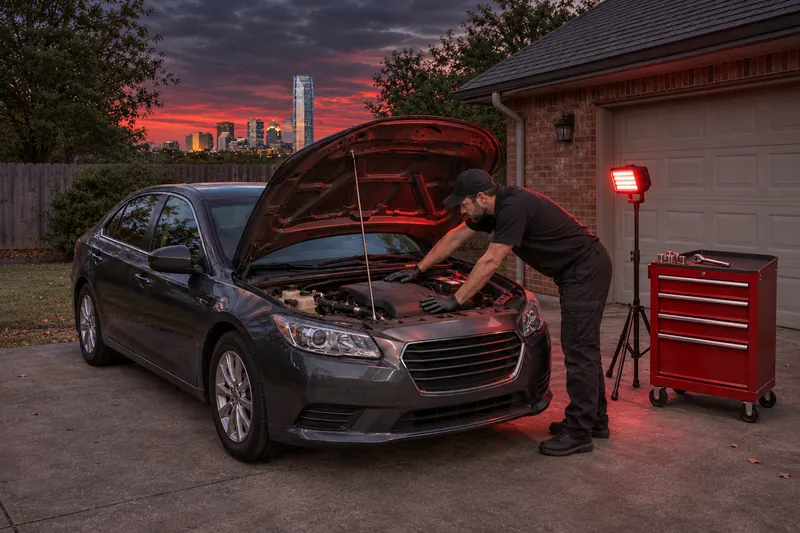
Oklahoma City is a city built around the car. It covers more than 600 square miles, one of the largest cities in the country by land area, its neighborhoods are tied together by interstates and turnpikes, and its weather swings from upper-90s summers to hailstorms to ice storms and the occasional deep freeze. All of that shapes what goes wrong with cars here, and why more OKC drivers are having the mechanic come to them.
This guide covers how mobile mechanic service works across the city, what Oklahoma conditions do to your car, and how to get the most out of a mobile visit.
What "mobile mechanic" means
A mobile mechanic brings the repair to your car instead of the other way around. Scan tools, hand and power tools, jacks and stands, and common parts ride in the work vehicle. Most everyday repairs (brakes, batteries, starters, alternators, sensors, belts and diagnostics) can be done in a driveway or a normal parking space.
What you skip: the tow, the ride to the shop, the waiting room and the ride back. In a city this spread out, where a round trip to a shop can easily mean an hour or more on the road, that's often the bigger cost.
Across the city, neighborhood by neighborhood
We work all over Oklahoma City, and every part of the city has its own patterns.
Downtown, Bricktown and Deep Deuce. Lots of parking garages, apartment buildings and office towers. Most repairs fit fine in a garage space. Building rules sometimes limit work in residential garages, so mention them in your booking notes. Dead batteries in garages are common here, especially for cars that sit during the week.
Midtown, Automobile Alley and the Plaza District. A mix of apartments, older homes and small business lots close to I-235 and Classen Boulevard. Short trips and stop-and-go driving are hard on batteries and brakes.
Heritage Hills, Mesta Park and Crown Heights. Older homes on tree-lined streets, most with a driveway or garage, which makes for easy mobile repairs. Older cars are common here too, and we see plenty of cooling system and charging problems in summer.
Northwest OKC, Lake Hefner and Quail Creek. Mostly single-family homes, with lots of commuting on Lake Hefner Parkway, the Kilpatrick Turnpike and Northwest Expressway. The stoplights along Northwest Expressway and Memorial Road wear brakes accordingly.
Far north OKC. Longer commutes and many families with more than one car. A mobile visit can take care of more than one vehicle in a single trip, which is worth mentioning when you book.
Northeast OKC and the Adventure District. Neighborhoods around the zoo and up the I-35 and I-44 corridors, with plenty of school runs and short trips. Batteries and brakes are the usual suspects.
Capitol Hill, Stockyards City and the Wheeler District. South of the Oklahoma River, with historic streets, older homes and busy main roads. Easy driveway repairs, and many drivers here cross the river into downtown every day.
South OKC and the I-240 corridor. Large neighborhoods along I-240, I-35 and I-44 on the south side. Long distances to many shops make mobile service especially handy here.
The highways that shape OKC driving
Oklahoma City drivers spend real time on these roads, and they explain a lot about how cars wear here:
- I-35 runs through the middle of the city, north toward Edmond and south toward Moore and Norman.
- I-40 crosses the city east to west, past Tinker Air Force Base and Midwest City on the east side and on toward Yukon in the west. Downtown it runs along the Crosstown, just south of the core.
- I-44 cuts across the north and west sides of the city, from the Turner Turnpike toward Tulsa to the southwest side.
- I-235 (the Centennial Expressway) links downtown with I-44, and the Broadway Extension carries the traffic on north toward Edmond.
- I-240 runs along the south side of the city.
- The Kilpatrick Turnpike arcs across the north and west sides of the metro.
- Lake Hefner Parkway runs north past Lake Hefner on the northwest side.
Stop-and-go traffic is the hardest kind of driving on brakes, transmissions and cooling systems. Long idles in summer traffic, with the AC running full blast, push batteries, alternators and fans to their limits.
What Oklahoma weather does to your car
Heat. Oklahoma City summers bring long runs of afternoons in the upper 90s, and some summers bring weeks of 100-degree days. Engine bays get far hotter than the air. Heat is the number one killer of car batteries, speeds up wear on belts and hoses, and stresses cooling and AC systems. Read more in our post on mobile battery replacement in Oklahoma City.
Hail and storms. Central Oklahoma sits in the heart of Tornado Alley, and spring storms across the metro often bring hail big enough to dent panels and crack windshields. Hail is mostly a body shop problem, but it's also a reason to inspect any used car carefully before you buy. See our pre-purchase inspection page.
Ice and cold snaps. Oklahoma winters swing hard. In October 2020 an early ice storm brought down trees and power lines across the metro, and in February 2021 Oklahoma City dropped well below zero. A battery the summer already weakened often gives up on the first really cold morning, which is why no-start calls spike when the first hard freeze comes through.
Wind and dust. Oklahoma is one of the windiest states in the country, and the wind carries dust that fills engine and cabin air filters faster than you might expect.
No inspections or emissions tests in Oklahoma
Oklahoma doesn't require yearly safety inspections or emissions tests for passenger cars, so renewing your tag doesn't involve a check of the car at all. That's convenient, but it also means nobody else is looking at your brakes, tires or warning lights. A check engine light that's been on for months, worn brakes or a tired battery won't stop you at the tag agency, so it's worth having a mechanic look things over now and then. If a warning light is on, get it diagnosed before a small problem grows.
The repairs OKC drivers book most
- Batteries. Heat-weakened batteries fail all year, and especially on cold mornings. See battery replacement.
- Brakes. Highway traffic and city stoplights wear pads and rotors. See brake repair.
- No-starts. Battery, starter, alternator, fuel or ignition. See car won't start.
- Check engine lights. With no emissions test to force the issue, many stay on for months. See check engine light diagnostics.
- AC. Warm air in July is not something anyone in Oklahoma waits on. See car AC repair.
- Starters and alternators. See starter and alternator repair.
How to get the most from a mobile visit
- Give the exact location. The street address, plus a gate code, garage level or parking spot number if there is one.
- Describe what the car is doing. Noises, warning lights, when it started and what you've already tried. It helps your mechanic bring the right parts.
- Use the VIN scanner. On your phone, the booking form can read the VIN from a photo of your dashboard or door sticker and fill in the car for you.
- Pick a realistic window. Same-day is often possible if you book in the morning. The form shows only the time windows still open today.
- Mention building rules. Some apartment complexes and HOAs limit repairs in parking areas. Tell us and we'll plan for it.
When a shop is the better call
Mobile repair covers most everyday work, but not everything. Transmission rebuilds, major engine work and jobs that need a vehicle lift belong in a shop. When your repair is one of those, your mechanic will tell you straight away.
Ready when you are
From Bricktown garages to Capitol Hill driveways to Quail Creek cul-de-sacs, we bring the repair to you. Book a visit in about two minutes, or call if you'd rather talk it through.